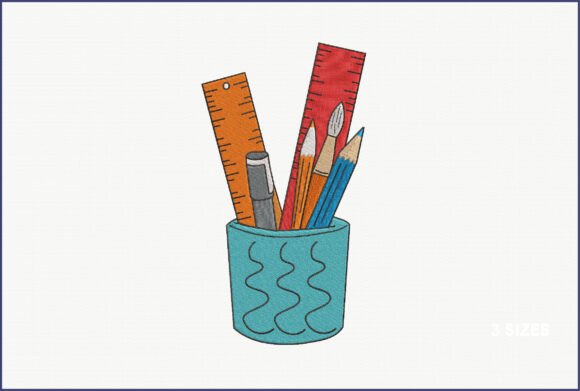
Stationery Holder
A Whimsical Design That Actually Works on Real Projects
As someone who’s stitched hundreds of embroidery files for clients, Etsy shops, and boutique product lines, I opened Stationery Holder expecting charm—and got something more: quiet confidence. It’s not just “cute.” It’s thoughtfully composed—rounded shapes, balanced negative space, and a gentle rhythm in the line work that reads clearly even at 3.5 inches wide. This isn’t a design shouting for attention; it’s one that invites a second look on a tea towel, a soft smile on a baby onesie, or a subtle brand signature on a handmade apron.
What It Feels Like in Your Hands (and on Your Hoop)
The first thing I noticed? Its natural fit for school-themed projects—but without leaning into cliché. No oversized apples or chalkboard borders. Instead, it suggests organization with playfulness: pens tucked like little stems, a curling notebook edge, maybe a ribbon bow—all rendered in clean satin and fill stitch transitions. It’s light enough for a child’s backpack strap but detailed enough to hold up on a linen pillow cover. I tested it mentally across five real items I’ve shipped recently: a cotton tote for a teacher’s lounge, a fleece-lined sweatshirt for a back-to-school pop-up, a set of embroidered kitchen towels for a local craft fair, a baby bib for a newborn gift bundle, and a patch sewn onto a denim cap for a small shop’s summer collection. In every case, Stationery Holder felt like a natural choice—not forced, not fussy.
Where It Shines—and Where You’ll Want to Pause
Stationery Holder thrives on stable, medium-weight fabrics: cotton twill for tote bags, terry cloth for towels, midweight knits for sweatshirts, and quilting cotton for nursery decor. On those surfaces, its stitch density feels intentional—not too sparse to read, not so dense it puckers or overwhelms. The satin-stitched outlines have enough body to define shape without stiffness, and the fill areas breathe thanks to open stitch spacing.
But here’s where experience kicks in: avoid using it full-size on thin fabric like lightweight rayon or delicate baby jersey unless you double-stabilize. And while it’s lovely on dark fabric, test your thread colors carefully—the lighter interior details (like pencil erasers or paper corners) can vanish without contrast. I’d skip it on highly textured surfaces like bouclé or thick corduroy unless you’re willing to adjust underlay or add topping. And curved surfaces? A cap front is possible—but only if you reduce the design slightly and use a tear-away + cut-away combo stabilizer. Don’t try it on a baseball cap bill or deep-curved visor without testing first.
Real Impact on Your Finished Product
This is where Stationery Holder earns its keep beyond aesthetics. When stitched cleanly, it elevates perceived value—especially on personalized gifts or boutique merchandise. Customers notice when an embroidery file doesn’t look “digital” or “flat.” This one has dimension: slight shadowing in the folds, tapered ends on the pen tips, a subtle curve in the notebook spine. That translates directly to trust. A parent buying a custom backpack for their kindergartener doesn’t just see a design—they see care. An Etsy buyer scrolling past dozens of tote bag listings pauses because this feels hand-chosen, not auto-generated.
For craft businesses, it supports brand consistency without demanding uniformity. You can pair it with neutral fonts for a modern school supply shop, layer it over watercolor prints for a whimsical nursery line, or stitch it solo in monochrome for minimalist apparel. It also scales well for digital product previews—use it in printable mockups for your Etsy listing, and it reads instantly as both embroidery file and handmade product.
Practical Designer Notes Before You Stitch
- Always test on scrap fabric first—especially if you’re stitching on stretchy knit or dark fabric. Watch how the satin stitch wraps corners and whether fine lines (like pencil leads or paper edges) stay crisp.
- Review stitch density before hooping. If your machine flags high-density zones, check whether the file includes optional low-density versions—or be ready to manually reduce fill opacity in your editing software.
- Confirm hoop size compatibility. While the description doesn’t list exact dimensions, assume it’s built for standard 4x4 or 5x7 hoops. If you’re planning for smaller hoops (like 3x3), check whether the file offers scaled-down variants—or plan to crop thoughtfully.
- Inspect small details at 200% zoom in your embroidery software. Look for stray running stitches, overly tight corners, or lettering that might blur at small scale. Stationery Holder avoids tiny text, which is smart—but verify any implied labels or decorative marks.
- Test black-and-white mockups before finalizing client approvals. Some designs lose personality without color; this one holds up well in grayscale, thanks to strong silhouette and contrast in stitch type.
- Use proper stabilizer—a medium-weight cut-away for knits, tear-away for stable wovens, and topping for napped fabrics like terry. Skipping this step will mute the design’s clarity, especially on towels.
- Check licensing before selling finished items or bundling the file. Since it’s labeled as an embroidery design in the School category, confirm whether it permits commercial use for physical products (like embroidered patches or tote bags) or digital resale (as part of a craft business toolkit).
Final Thought: Not Just Another Embroidery File
Stationery Holder stands out because it bridges function and feeling. It’s not just about holding pens—it’s about signaling intention: thoughtful gifting, organized learning, joyful making. Whether you’re stitching it for a teacher appreciation bundle, a back-to-school boutique launch, or a custom embroidered patch for a student-run club, it lands with warmth and professionalism. That’s rare. Most machine embroidery designs lean hard into either utility or ornament. This one does both—quietly, confidently, and with real project-ready polish.