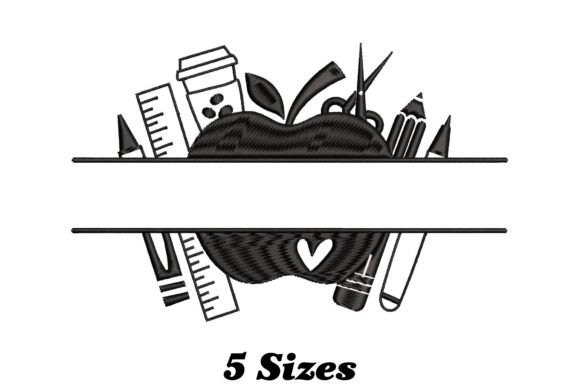
Retro Floral Teacher
A Practical Embroidery Designer’s Review for Small Business Merch
As an embroidery designer who’s developed hundreds of commercial embroidery files for cafés, boutiques, florists, bakeries, and handmade studios, I approach every new design with two questions: Does it reinforce brand identity at a glance? and Will it stitch cleanly across real-world merchandise? When I first saw Retro Floral Teacher, the title alone signaled something distinct—nostalgic but not dated, floral but not fussy, teacher-themed but broadly appealing. That’s rare. In small business merch, where every stitch carries branding weight, this balance matters more than ornamentation.
First Impression: Friendly, Handmade, and Professionally Whimsical
Retro Floral Teacher reads as warm, approachable, and intentionally crafted—not generic clip art disguised as embroidery. The “retro” cue suggests soft curves, balanced negative space, and stylized botanical elements; “floral” implies organic flow rather than rigid symmetry; “teacher” anchors it in purpose without leaning into clichés like apples or chalkboards. For a florist launching branded totes, a bakery embroidering aprons for staff, or a creative studio gifting embroidered towels to workshop attendees, Retro Floral Teacher feels personal yet polished—like a signature, not a sticker.
Real-World Performance Across Business Applications
This machine embroidery design shines where small businesses need versatility: as an embroidered patch sewn onto denim jackets or canvas bags; as a subtle chest accent on custom apparel for café baristas or boutique associates; as a sleeve detail on linen aprons that elevates handmade product perception; or as front-cap embroidery for team-branded headwear at local markets or school events.
On tote bags and reusable shopping sacks—key merch for eco-conscious brands—Retro Floral Teacher holds visual weight without overwhelming. Its playful rhythm supports storytelling: a florist uses it to signal care and craft; a pet brand repositions it as “teacher of tails and treats”; a creative studio adopts it as a gentle nod to mentorship and growth. Even in school-adjacent contexts—like after-school program staff uniforms or PTA event swag—it avoids childishness by favoring charm over cartoonishness.
For Etsy sellers and crafters offering personalized gifts, this embroidery file works beautifully as a finished product add-on: stitched onto tea towels, baby blankets, or ceramic mug sleeves (via fabric labels). As part of a cohesive set of design assets, it pairs well with minimalist typography or hand-drawn icons—never competing, always complementing.
Where to Use It Thoughtfully
Like any strong design, Retro Floral Teacher benefits from intentional placement. Avoid shrinking it below 2.5 inches wide for patches—fine details may blur or lose definition on curved surfaces like cap fronts or tapered tote handles. On dark uniforms or textured fabrics (e.g., heavy canvas or terry cloth), confirm thread color contrast early: light pastels may fade visually unless paired with matte or slightly heathered threads.
Review stitch density before production. While the description notes it’s “playful” and “whimsical,” high-density fills in floral centers or tight outlines can cause puckering on lightweight tees or delicate linens. If your small business merch includes items meant for frequent washing—think staff aprons or kids’ camp shirts—opt for satin-stitched borders over dense fill areas where possible, and always test on the actual fabric.
Brand Identity & Customer Perception
In merch, consistency builds trust. Retro Floral Teacher strengthens brand identity by delivering warmth without sacrificing professionalism. Customers don’t just see a flower—they register care, continuity, and intention. That translates directly to perceived value: an embroidered tote bag with this design feels more considered—and therefore more worth purchasing—than one with a generic vector logo.
For handmade brands especially, it signals authenticity. Unlike mass-produced graphics, this embroidery file reads like it was drawn first, digitized second—a subtle cue that resonates with buyers who prioritize craftsmanship. Used across packaging accents (fabric tags, gift wrap seals) and customer thank-you gifts, it creates visual consistency that reinforces recognition across touchpoints.
Practical Notes Every Embroidery Designer Should Confirm
- Test in black and white first—to assess contrast, spacing, and silhouette clarity before committing to thread colors.
- Check minimum viable size—does Retro Floral Teacher retain legibility and charm at 2 inches? If not, simplify outlines or adjust petal spacing before digitizing.
- Review thread color pairings—especially for small business clients using branded palettes. Does it translate well in navy + cream? Sage + charcoal? Test digitally and physically.
- Confirm hoop size compatibility—will it fit standard 4x4 or 5x7 hoops used in most commercial embroidery setups? If oversized, note resizing constraints for cap embroidery or narrow sleeves.
- Stabilizer selection is non-negotiable—use cutaway for knits, tear-away for stable wovens, and mesh for lightweight silks or linens. Mismatched stabilizer = distorted finished product.
- Create a printable mockup for client approval—show it scaled on a real apron photo or cap flat lay, not just a white background.
- Compare beside other design assets—does it harmonize with your current logo, typography, or packaging? Consistency prevents visual fatigue.
- Verify commercial licensing before use in paid projects—this is essential for embroidery shops selling custom apparel or digital embroidery file resellers.
Finally, remember: Retro Floral Teacher isn’t just a decoration. It’s a tool—for telling stories, building recognition, and turning everyday items into brand ambassadors. Whether stitched on a teacher’s tote, a florist’s apron, or a bakery’s staff shirt, it carries tone, texture, and intention. And in small business merch, that’s not whimsy—it’s strategy.